

BIOGRAPHY
Giacomo Puccini was born in Lucca on 22 December 1858 into a family that had been devoted to music for four generations, on both his father’s and mother’s sides. His father, Michele (1813–1864), died when Giacomo was just over five years old, and the boy’s musical education was entrusted to his maternal uncle Fortunato Magi, and later to Carlo Angeloni, both former pupils of his father. Following family tradition, Puccini became a choirboy (1868), then an organist (1872); and in this capacity he was also active as a precocious composer.
In 1874 he was admitted to the Pacini Music Institute in Lucca, and two years later he composed the Prelude for orchestra. In 1880, he took his leave of Lucca with a Messa di gloria, which was very well received; drawn to the theatre, he moved to Milan in November to sit the entrance examination for the Conservatory, where his teachers were Antonio Bazzini – for just over a month – and Amilcare Ponchielli.
In July 1883, he completed his studies by having his *Capriccio sinfonico* performed as his final recital piece, conducted by Franco Faccio, and it was very well received.
In October, the publisher Sonzogno published the song for voice and piano Storiella d’amore; at the same time, he was working on a one-act opera, Le Willis, based on a libretto by Ferdinando Fontana, which he had secured thanks to Ponchielli’s intervention, and with this work he entered the first Melodramatic Competition organised by Sonzogno. The opera did not win a prize but, thanks to the help of some friends (including Ponchielli, Fontana, Arrigo Boito and Giulio Ricordi), it was performed on 31 May 1884 at the Teatro Dal Verme in Milan, where it was a great success. Ricordi purchased it and commissioned the composer to write another.
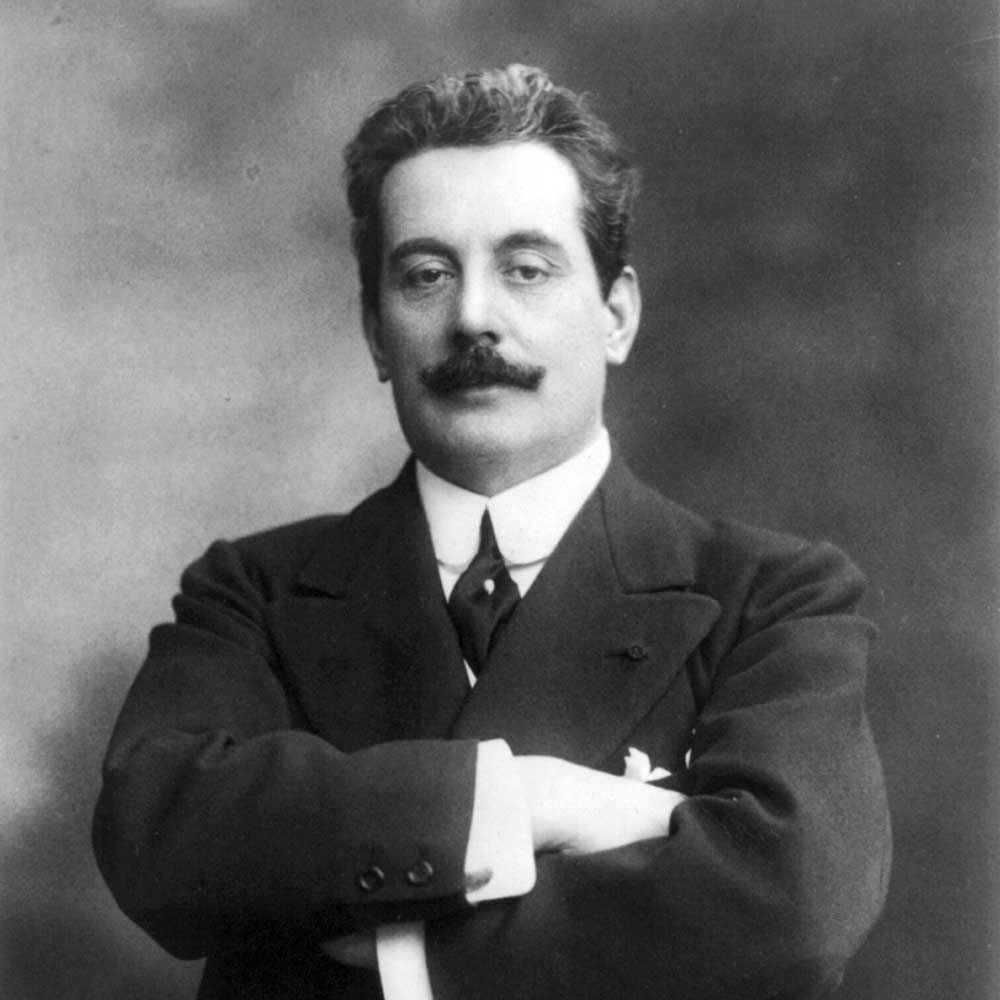

These were difficult times for Puccini, who had by then settled in Milan and was considering new subjects: Sardou’s *Tosca* and Prévost’s *Manon Lescaut*. The latter subject was chosen, despite the risk of a dangerous comparison with Massenet’s acclaimed opera, and in 1890, after arduous collaborative work between Ricordi, Leoncavallo, Domenico Oliva and Marco Praga, the libretto was ready and Puccini could begin composing it in his new home in Torre del Lago. But before the opera could be considered complete (autumn 1892), the libretto had to undergo extensive revisions, entrusted to Luigi Illica with the advice of Giuseppe Giacosa.
On 1 February 1893, the triumph of *Manon Lescaut* brought an end to a long period of uncertainty: not only was the subject matter more suited to him, but the realisation that he needed to exercise close control over the libretto’s development also lay at the heart of the mastery he had achieved.
In July 1900, Puccini saw Long and Belasco’s play *Madame Butterfly* in London: this subject was chosen, setting aside other ideas, including one based on Marie Antoinette. Illica and Giacosa were still at work, grappling with their usual doubts; but the slow progress this time was also caused by a serious car accident (February 1903), which left Puccini with a broken leg and a particularly long convalescence. The first version of Madama Butterfly, in two acts (Milan, La Scala, 17 February 1904), was a resounding failure; but just three months later, the revival in Brescia, in three acts, with some alterations and extensive cuts, sealed the opera’s success. Now there was renewed talk of Marie Antoinette, and of a trilogy based on stories by Gorky; it was also a time of trips to London and a long stay in Buenos Aires (1905). Then came New York (1907), where Giacomo Puccini had the opportunity to see a play by Belasco, which would form the basis of his new opera La fanciulla del West. The librettists this time were Carlo Zangarini and Guelfo Civinini, and the premiere took place, to great acclaim, at the Metropolitan in New York (10 December 1910).

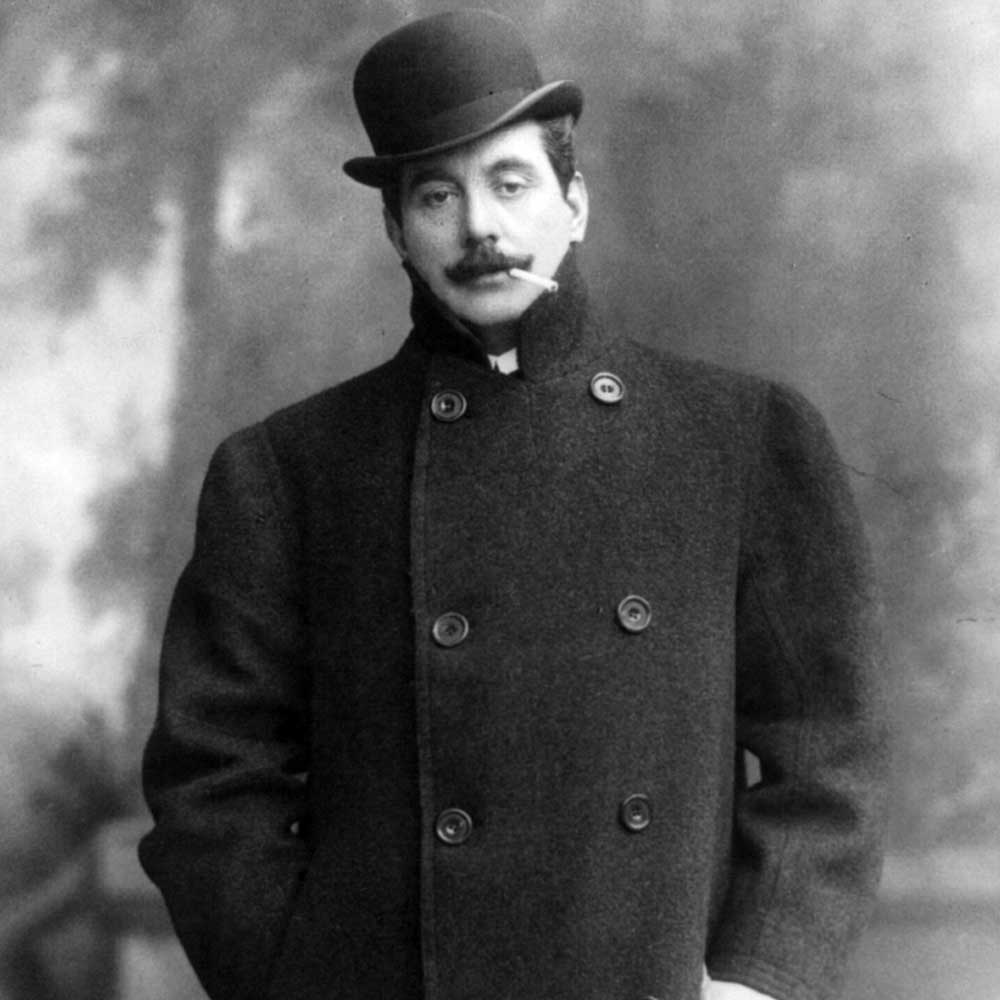
It was a project that occupied Puccini for several years, with a particularly chequered history, partly because the composer was suffering from throat problems which, in October 1924, were diagnosed as cancer. By the end of 1923, *Turandot* was almost complete, but the final duet was still missing, and its libretto was painstakingly reworked. Whilst these revisions and rewrites were underway, in September 1924 Giacomo Puccini made arrangements with Toscanini for the opera’s premiere, scheduled for the following April; however, on 4 November, with the final duet still unwritten, Puccini left for Brussels, where he was admitted to a clinic. On the 24th he underwent throat surgery, and died on 29 November 1924.
Taken from: *Dizionario Pucciniano* by Eduardo Rescigno, published by Ricordi
Le Villi, a new version of Le Willis
Ballet opera in two acts, libretto by Ferdinando Fontana, based on the novella Les Wilis (1852) by Alphonse Karr.
Premiere: Turin, Teatro Regio, 27 December 1884
Edgar
Premiere: Teatro alla Scala, 21 April 1889
New version Opera in three acts Premiere: Ferrara, Teatro Comunale, 28 January 1892
Final version in three acts Premiere: Buenos Aires, Teatro Colón, 8 July 1905
Premiere: Turin, Teatro Regio, 1 February 1893
Final version: Milan, Teatro alla Scala, 7 February 1894
Premiere: Turin, Teatro Regio, 1 February 1896
Tosca
Premiere: Rome, Teatro Costanzi, 14 January 1900
Madama Butterfly
A Japanese tragedy in two acts, with a libretto by Luigi Illica and Giuseppe Giacosa based on John Luther Long’s short story *Madame Butterfly* (1898) and the Japanese tragedy of the same name (1900), which Long and David Belasco adapted from the short story.
Premiere: Milan, La Scala, 17 February 1904
Second version
in two acts,
the second divided into two parts
Brescia, Teatro Grande, 28 May 1904
Third version
in two acts,
London, Covent Garden, 10 July 1905
Final version
in three acts (in French)
Paris, Opéra Comique, 28 December 1906
in three acts (in Italian)
New York, Metropolitan Opera House, 10 February 1907
Italian premiere: Rome, Teatro Costanzi, 12 June 1911
Premiere: Monte Carlo, Théâtre de l’Opéra, 27 March 1917
Triptych: *Il Tabarro*, *Suor Angelica*, *Gianni Schicchi*
Premiere: New York, Metropolitan Opera House, 14 December 1918
Italian premiere: Rome, Teatro dei Costanzi, 11 January 1919
Suor Angelica A one-act opera, libretto by Giovacchino Forzano
Premiere: New York, Metropolitan Opera House, 14 December 1918
Italian premiere: Rome, Teatro dei Costanzi, 11 January 1919
Gianni Schicchi An opera in one act, libretto by Giovacchino Forzano, based on the ‘Anonimo Fiorentino’s’ Commentary on the Divine Comedy, published by Piero Fanfani (1866)
Premiere: New York, Metropolitan Opera House, 14 December 1918
Italian premiere: Rome, Teatro dei Costanzi, 11 January 1919
First posthumous performance completed by Franco Alfano: Milan, Teatro alla Scala, 25 April 1926
1876 – Preludio a orchestra in Mi minore-maggiore.
ante 1880 – A te, per voce e pianoforte
1877 – Mottetto per San Paolino «Plaudite Populi»
1878 – «Credo» per tenore, coro e orchestra
1878? – Vexilla Regis, inno per coro maschile e organo
1878-80 – Messa a quattro voci con orchestra per soli (tenore e baritono) coro e orchestra
1881-3 circa – Largo Adagetto in Fa maggiore per orchestra
1882 – Preludio sinfonico in La maggiore per orchestra
1882 circa – Quartetto d’archi in Re maggiore
1881-1883 circa- Fughe reali per quartetto d’archi.- Andante poco mosso in Do minore;Andante sostenuto in La maggiore – Fughe a quattro voci
Moderato in Re minore, Largo in Do minore, Allegro moderato in Sol maggiore, Moderato sostenuto in Do maggiore, Largo in Mi minore, Sol maggiore, Do maggiore, Andante mosso in Sol maggiore, Piuttosto lento in Sol minore
1883 – Salve Regina, per soprano e armonium
1883 – Capriccio sinfonico in Fa maggiore per orchestra
1883 – Mentìa l’avviso, recitativo e aria per tenore e pianoforte
1883 – Ad una morta, lirica per mezzosoprano o baritono e pianoforte
1883 – Storiella d’amore, melodia per canto e pianoforte
1884 – Tre minuetti per quartetto d’archi
1888 – Sole e amore, mattinata per canto e pianoforte
1890 – Crisantemi, elegia per quartetto d’archi
1894 – Piccolo valzer per pianoforte
1896 – Avanti Urania!, lirica per voce e pianoforte
1897 – Inno a Diana, per canto e pianoforte
1899 – E l’uccellino, ninna nanna per canto e pianoforte
1899 – Scossa elettrica, marcia per pianoforte
1902 – Terra e mare, lirica per canto e pianoforte
1904 – Canto d’anime, pagina d’album per canto e pianoforte
1905 – Requiem per coro a tre voci, viola, armonium o organo
Eseguito a Milano, il 27 gennaio 1905, in occasione del quarto anniversario della morte di Giuseppe Verdi.
1905 – Ecce Sacerdos magnus, per coro a quattro voci.
1905 – Dios y Patria, per voce e pianoforte
1908 – Casa mia, casa mia, lirica per canto e pianoforte
1907 o 1910 – Piccolo tango per pianoforte
1907 o 1910 – Foglio d’album per pianoforte
1912 – Sogno d’or, ninna nanna per voce e pianoforte
1916 – Pezzo per pianoforte (Calmo e molto lento).
1917 – circa – Morire?, lirica per canto e pianoforte
1919 – Inno a Roma, per canto e pianoforte